


Carving a Niche
To bridge technology and art, Martini developed a research project, Human Contributions to Digital Fabrication, transforming digital photographic images into three-dimensional sculptures using 3D printing, laser and plasma cutting, and experimenting with materials like plastic, plywood, plexiglass, steel and aluminum.
The project was supported through a Summer Undergraduate Research with Faculty grant and was designed “to explore how technology can enhance the human experience often consumed by the digital world.”
“Art is about connection, so I did want to bring that human element into it,” says the senior studio art major, who is fascinated by environmental portraiture because of how personal and intimate it can be to capture someone in their own space. “It often leads to deeper and more valuable conversations when they are in a comfortable and familiar space.”
And so that’s where she started – by visiting people in their own spaces. Specifically, she connected with women over the age of 65 who have lived in Charleston their entire lives. Using the Nextdoor app, she found six women who allowed her to visit them in their homes, where she interviewed and photographed them.
“I was surprised how open the women were,” says Martini, who grew up in Mt. Pleasant.
Connecting the women’s homes to technology was the more challenging and exciting part.
Martini, whose focus had always been photography, was introduced to the cutting-edge technology and expanded possibilities in the new Simons Center Sculpture Studio while taking sculpture classes with Jarod Charzewski, assistant professor of studio art. Intrigued by the art form, she wanted to take the familiarity of photography and manifest it through sculpture.
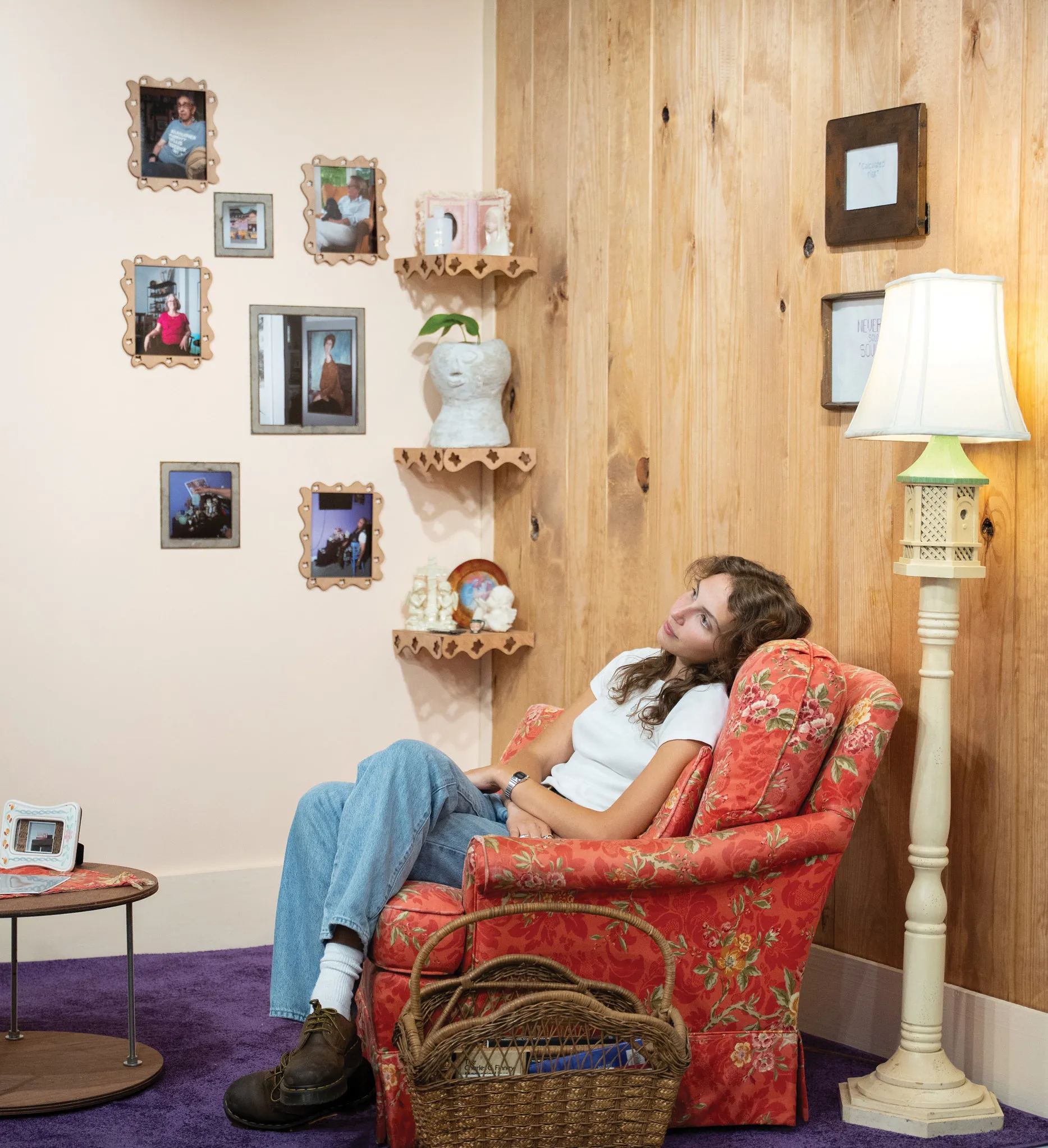
“Once I had the photography portion, I thought, I’m going to create a fictitious living room,” says Martini, who – after compiling her photography into a book, The Women Who Stayed – used the highly technological equipment in the Sculpture Studio to make replicas of items she photographed in the women’s homes.
The installation she created (pictured) combines the homes and interviews of all the women through things like tables, knickknacks, clocks, wood paneling and shelving. From the fabric of the chair inspired by the wallpaper in one of the women’s houses to the framed cross-stitched quotes (“Calculated Risk” and “Never Sold My Soul for a Job”) in others: everything she created connected to the women. “I was able to work with older women and technology and connect the two in an unexpected way.”
Because of the new studio and technology, if you can dream it, you can build it, says Charzewski. “So much more is at our fingertips.” And it’s becoming more and more second nature to use this equipment and technology – something that’s much more intuitive to younger generations.”
Notes Martini: “I had never done any of this before. I was ready for something new. I was a novice sculptor, but now I have the confidence to work with all sorts of equipment and technology, and I know I can build pretty much anything.”