

Secrets of the Deep
Sarlo was excited about the five-day trip aboard the Nancy Foster, but the first day wasn’t what he imagined.
“I was seasick,” he says. “It was overwhelming at first. I only knew two people, so I was nervous – but everyone was welcoming. The crew answered all my questions, and the food was great. I got to explore parts of the seafloor no one’s seen before and take a big step toward my future career.”
The group also surveyed the seafloor for deep-sea corals 100 nautical miles off the South Carolina coastline.
“The moment we found the corals was different for almost every person on board,” says Sarlo, who is from Greer, S.C. “For the students, myself included, it was a great moment of wonder and excitement. There was something special about the first time discovering something on the seafloor in real time.”
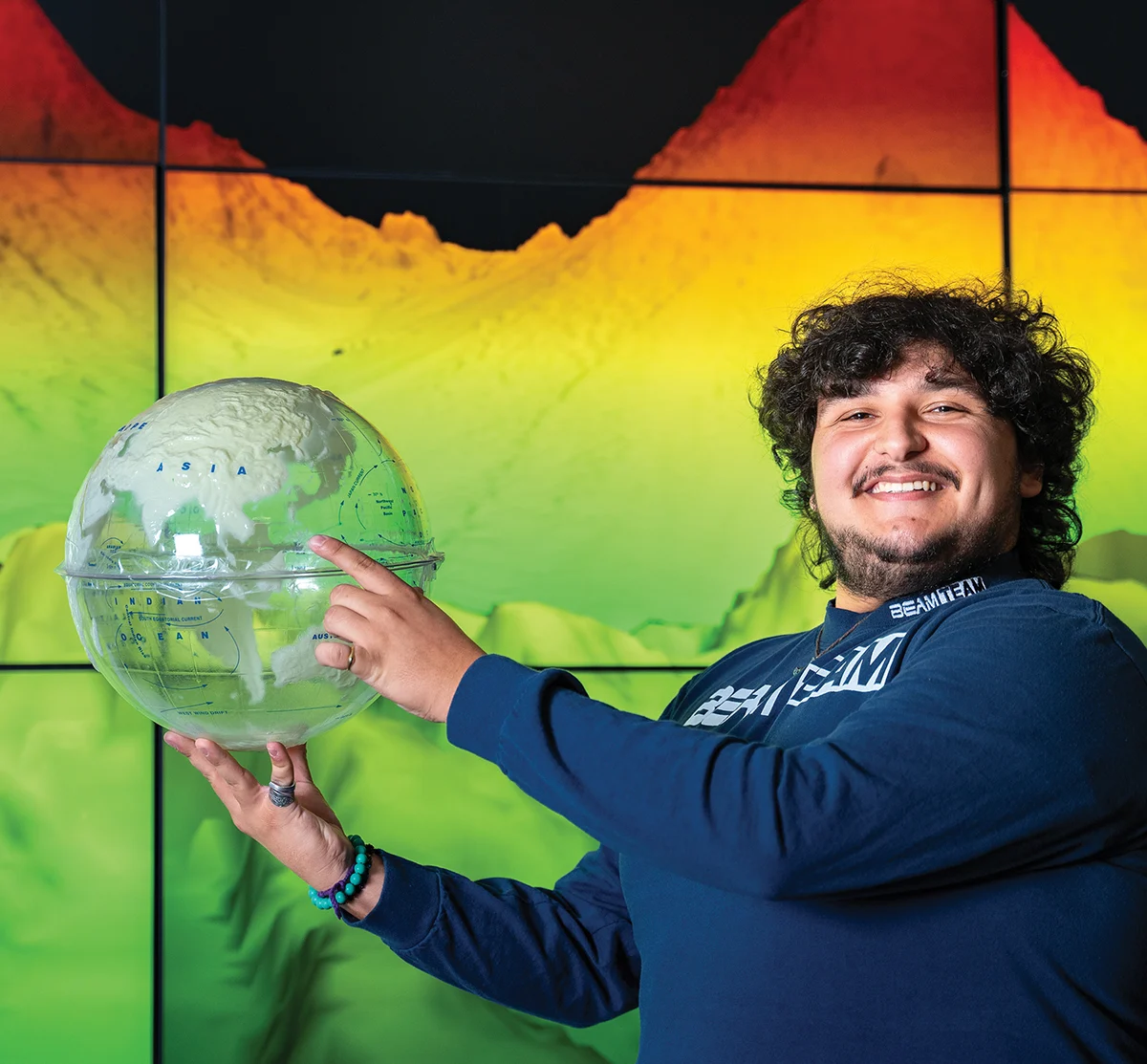
In addition to discovering deep-sea corals, Sarlo learned more about seafloor mapping, which involves several steps, starting with determining depth. For this, a multibeam echosounder is often used, as it covers wide areas while the boat moves — like mowing a lawn in stripes. The collected data is then processed using software to create detailed maps of the seafloor.
“On top of learning so many skills and working on one of the coolest boats in the NOAA fleet, I made lifelong connections with students from around the country that I will cherish for the rest of my life,” says Sarlo. “I would deeply encourage any student who can get this opportunity to fight tooth and nail for it. It was one of the most valuable things I have done during my academic career.”
Conducting research on a NOAA ship was part of Sarlo’s Summer Undergraduate Research with Faculty grant. He continues to work alongside Haley Cabaniss ’15, assistant professor of geology and environmental geosciences and director of the Benthic Acoustic Mapping Program, to expand a submarine volcano database and identify traits that help determine which ones pose a threat and which do not. Their work involves significant mapping and comparison with an existing satellite survey, which revealed about 43,000 submarine volcanoes.
Sarlo chose the College for the opportunities it would provide him to establish a firm foundation for his future. His experiences have been more than what he expected, and he looks forward to more opportunities.
“Nikolai has a passion for maps that is contagious,” says Cabaniss. “This, paired with his curiosity about submarine environments and his desire to engage in science that benefits society, makes him the perfect student to take on this work.”