

Aquatic Symbiosis
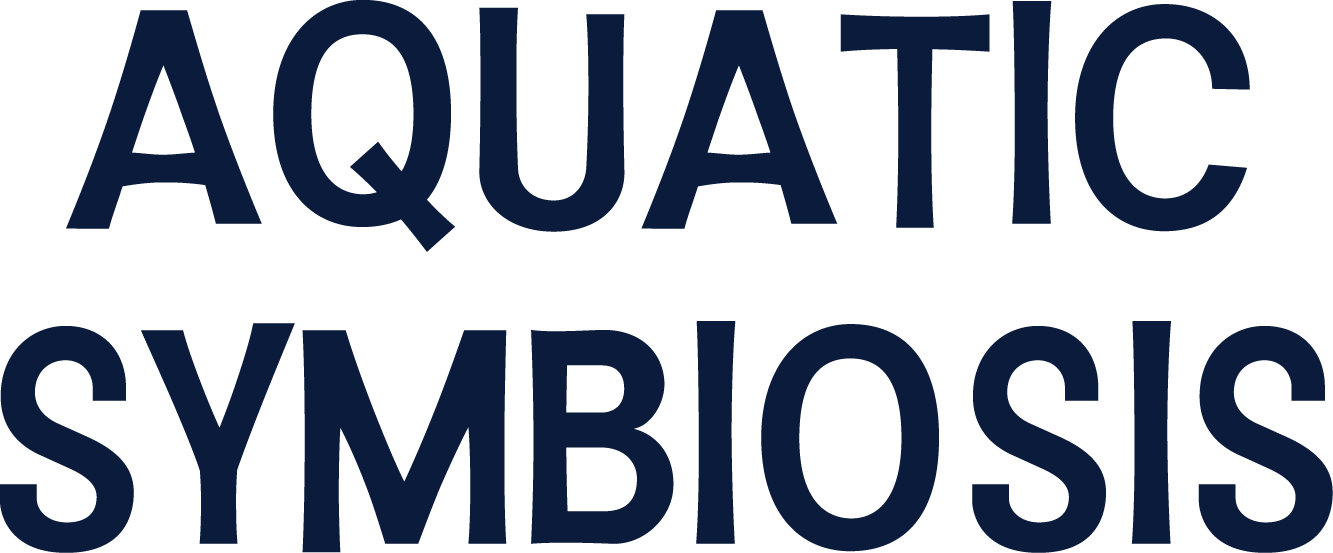
id-tide on a Wednesday morning, a calm Charleston harbor in front of Mt. Pleasant’s Alhambra Hall beckons a quick paddleboard session. The sun glints off the water in tinfoil-like shimmer as pelicans swoop down on prehistoric wings, gliding so impossibly low their bellies almost touch the glassy surface. Twenty minutes paddling out and 20 minutes back is the perfect way to start the workday, and enjoying moments like this is one of the perks of living in a city surrounded by – and yes, sometimes inundated by – water. A shrimp boat chugging out from Shem Creek is the only other traffic until a small motorboat slowly cruises by, careful not to cause a big wake. I wave, recognizing the crew – Andrew Wunderley ’05 (M.S.), Charleston Waterkeeper, and his team, headed out on “Water Quality Wednesday,” the day they go collect water samples at various testing points to ensure our local waterways are safe for swimming, fishing and people like me, who try not to take a dunk while paddleboarding but aren’t always successful.
“Come join us one morning,” Wunderley says as they boat off on their sampling mission. It’s an invitation he issues earnestly and widely, encouraging people from the broader community, especially College of Charleston students, to dip their hands in and learn more about our watery world and about his small nonprofit’s mission to “protect, defend and restore the health and integrity of Charleston’s waterways for people and nature.” In fact, Charleston Waterkeeper’s ongoing engagement with the College of Charleston student body and faculty has been a key part of the nonprofit’s growth and success since its founding by Cyrus Buffum ’06 in 2009.
“The College of Charleston has been instrumental every step of the way,” says Wunderley, a former competitive swimmer from Ohio who came to the Lowcountry in the mid-ʼ90s to coach swimming. Wunderley earned his master’s in environmental studies at CofC. An environmental law class inspired him to pursue his law degree from the Charleston School of Law. After law school, he clerked for the Court of Appeals and then for a judge for a few years and was looking for ways to combine his interests in environmental advocacy and law when a posting on the Charleston School of Law job board caught his eye.
“The opening was for legal affairs coordinator for Charleston Waterkeeper, and the posting was so ridiculously irreverent – something about low pay, ‘but hey, a boat is your office!’ – it was intriguing,” he recalls. Wunderley had never heard of Charleston Waterkeeper at the time, but he happened upon a story about Buffum and his nascent organization in this very magazine soon after seeing the posting. “So that made it feel legit and further intrigued me,” he says. “I realized the concept of a Waterkeeper brings together all my personal passions – swimming, surfing and my fundamental belief in the public’s right to clean water – so I applied.”
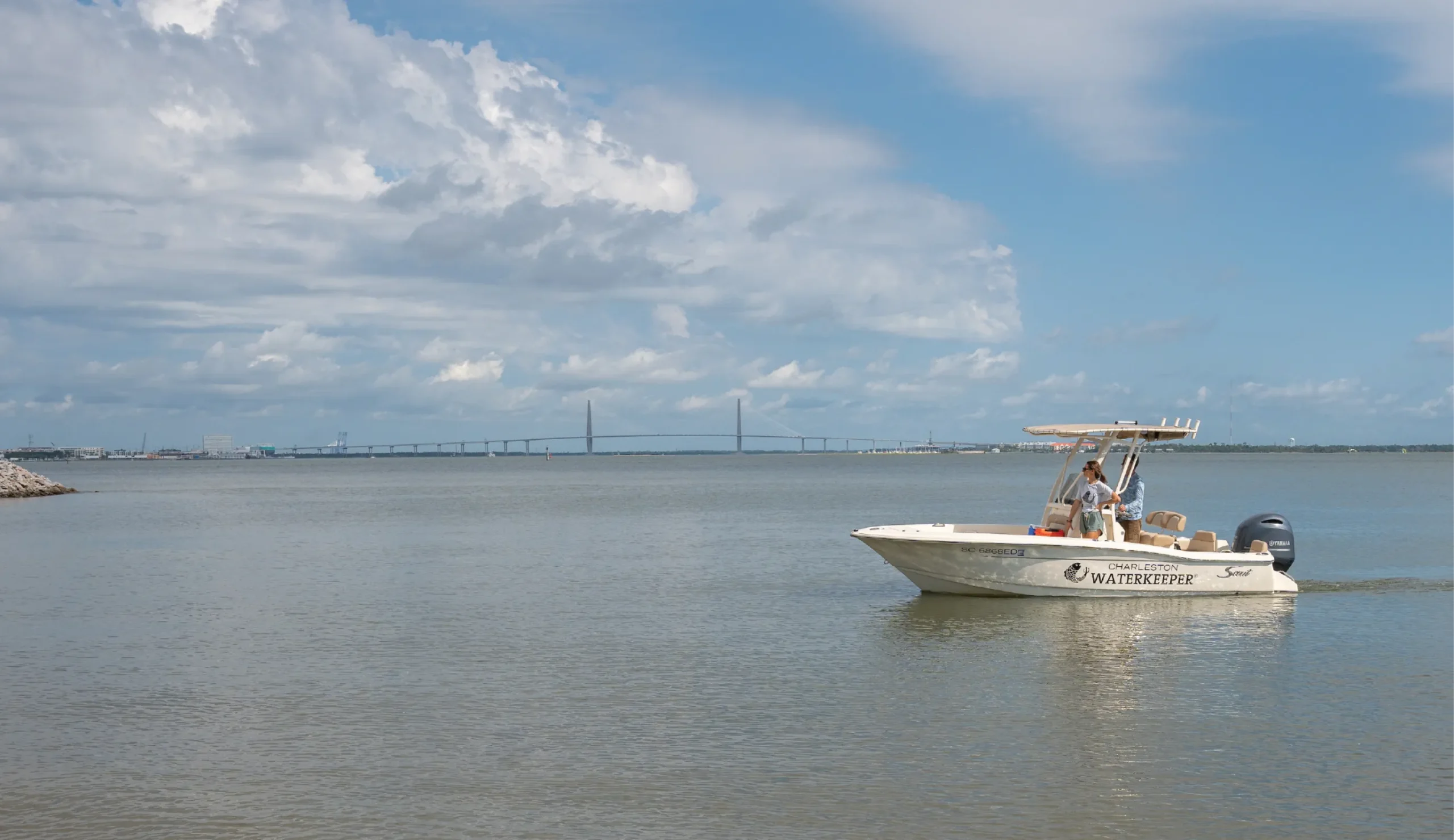
Though the global Waterkeeper Alliance provides a resource network for its far-flung affiliates, Charleston Waterkeeper, like all individual Waterkeepers around the country, operates as a stand-alone nonprofit, and when Wunderley was first introduced to it, “it was super-duper startup. I think I sat on an overturned recycling crate for my interview,” he recalls. Buffum was the only employee, “and may have still been only part time, and the board of directors had just been cobbled together.” That scrappiness, and what Wunderley saw as Charleston Waterkeeper’s huge growth potential, was much of the appeal. “I couldn’t get it out of my head. It just felt like something I had to take a swing at. I knew if I didn’t try it, I’d always regret it.” Wunderley joined as program director in 2011, and after Buffum stepped away in 2014, he has been at the organization’s helm – and its boat’s helm – since 2015.
“Waterkeeper uniquely uses science, the law and our deep knowledge of local waterways to be effective watchdogs and stewards for clean waterways,” explains Wunderley. “State law is clear that our marshes, rivers and beaches are part of the public trust – these are ours, they belong to everyone. We stand up to ensure existing environmental regulations are enforced.”
Do It Top-Notch
But enforcing regulations and watchdogging water quality is a huge task for a region surrounded by water. “Early on we were strategizing about how to build out our mission-driven work, and to begin doing water quality monitoring like many other Waterkeepers do,” says Wunderley. “So I thought, Let’s try to connect with the College on this.”
He arranged a meeting with Tim Callahan – then-chair of the geology and environmental geosciences department and director of the graduate program in environmental and sustainability studies – and Vijay Vulava, geology professor and current chair of the department, both of whom Wunderley knew from his master’s program.
“I went in all nervous,” he recalls. “I had my salesman hat on, my pitch prepared, and I’m thinking, OK, I’ve got to convince these guys that we need students and laboratory resources, yadda yadda. And, maybe three minutes into my spiel, Tim says, ‘I’ve got the perfect student. Her name’s Cheryl, and she’s in the Peace Corps Masters International Program. She’ll be starting with you next week.’”
Cheryl Carmack-Smith ’14 came to the College after studying biology at the University of Alabama, Birmingham. She loved lab work and wanted to continue in the sciences but also wanted real-world contact with people in the field.
“I had always been interested in water quality and was drawn to the College’s master’s program because it was so interdisciplinary with strong research focus on water quality, but also because it was so connected to the community,” says Carmack-Smith, noting the College’s Peace Corps Masters International Program required a community service internship. As a bonus, her two-year internship was funded – something the fledgling Waterkeeper otherwise wouldn’t have been able to afford.
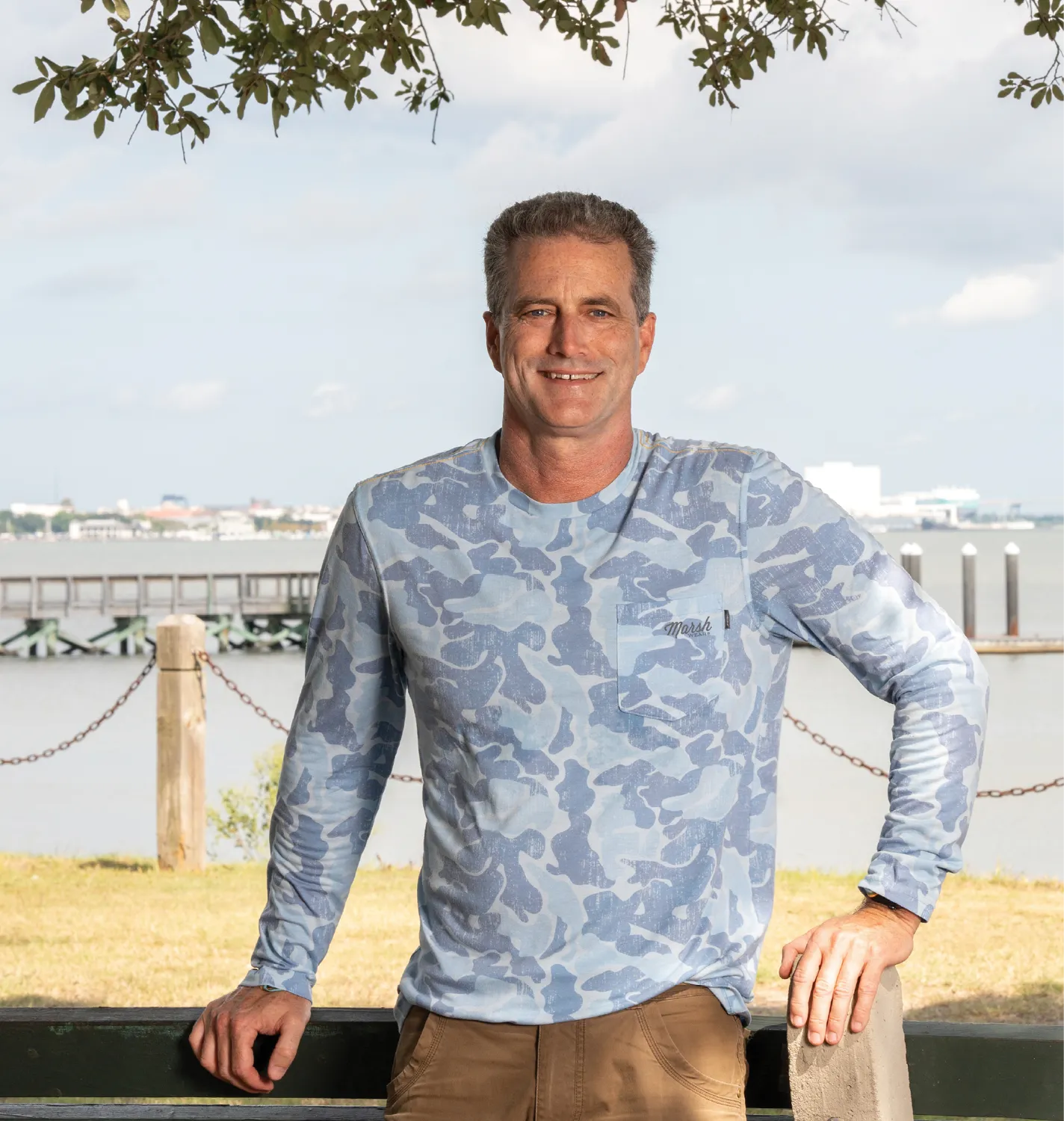
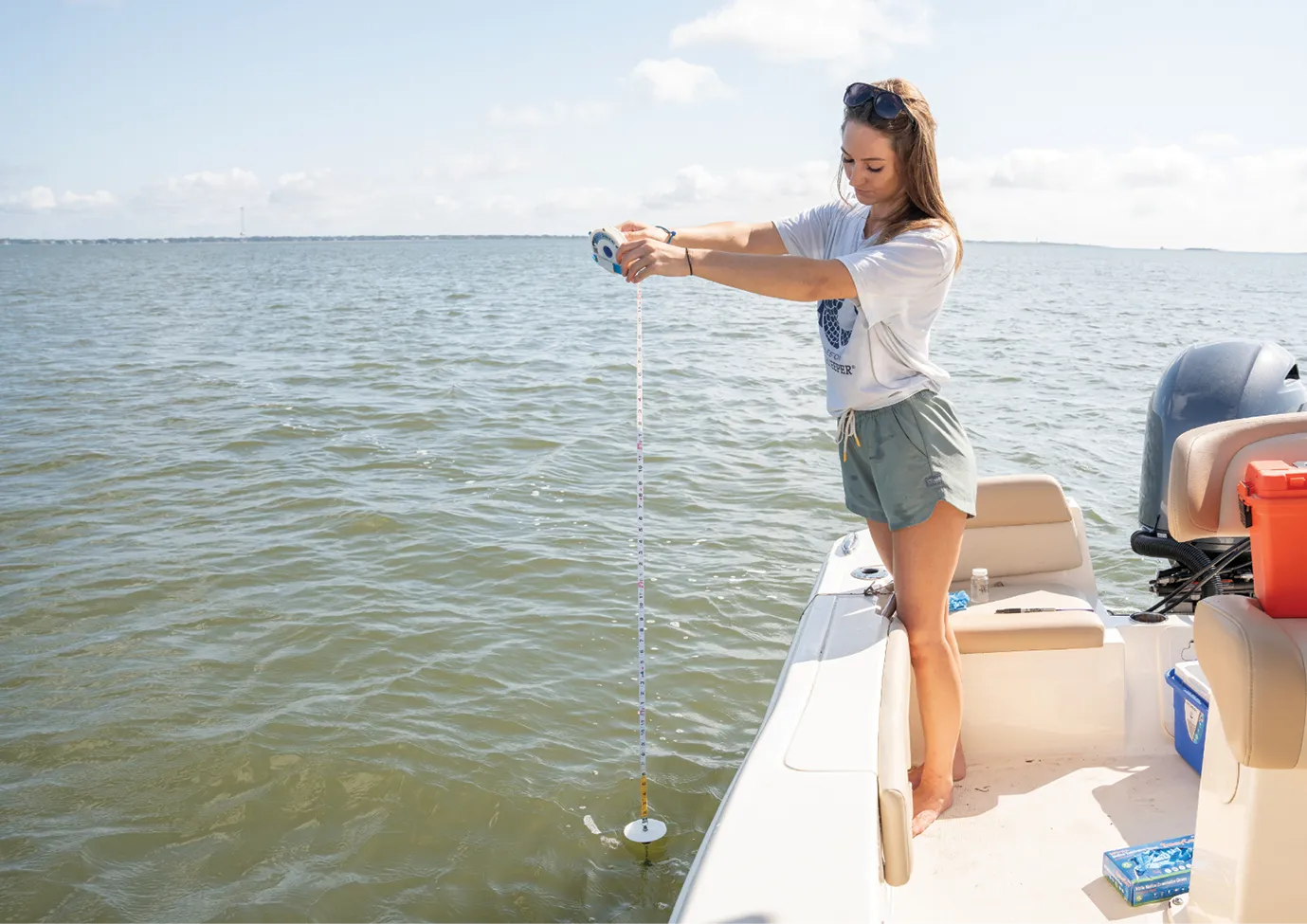
For her master’s thesis under the direction of Vulava, Carmack-Smith built out Waterkeeper’s signature water quality monitoring program, beginning with 12 testing sites (now 20). She established the sampling and testing protocols, looking at fecal enterococcus contamination and other water hazards, “ensuring we did it top-notch,” she says. Working with Vulava, she set up a state-approved biosafety Level-2 lab at the College, where samples are tested and then data is submitted to the South Carolina Department of Environmental Services and the U.S. Environmental Protection Agency.
“We devised the program, and I convinced my department that it was worthwhile, so we made the resources happen,” says Vulava, who, given his background in environmental geochemistry and pollution, was familiar with similar water quality methodology for freshwater. The timing was opportune: The Department of Geology and Environmental Geosciences’ Hydrochemistry Research Laboratory was moving to the new School of Natural and Environmental Sciences building on Calhoun Street, which meant he could request additional space as well as a new biosafety cabinet that uses negative pressure to protect from bacterial exposure; additional incubators; and a mini autoclave, all of which Charleston Waterkeeper has 24/7 access to.
“The College itself, not just the geology department, saw the value in this and made it work,” says Vulava, a member of Waterkeeper’s board of directors since 2014. “We’re giving students the hands-on experiential knowledge of how environmental contaminants impact us. The impacts are partly geological, as that’s how runoff happens, but it’s also biological and a human health issue.”
His undergraduate and graduate students get to take part in the Waterkeeper field sampling and run the samples in the lab. Carmack-Smith, who became the full-time program director for Waterkeeper in 2014, now holds an adjunct appointment at CofC, teaches students in various classes, gives them leads on fieldwork opportunities and advises those doing independent research projects.
“I get to train them in how to work in a certified lab and give them skills and standard methods that translate to any certified lab,” she says. “It always tickles me that we’re doing microbiology work in a geology lab, but I think it’s so cool for geology students to see that.”
Adds Vulava: “They learn how the kitchen works; they’re not just seeing the final meal. Because of the sophisticated lab skills they acquire, these students are getting hired by our local utilities and local governments right away.”
And for Charleston Waterkeeper, access to the College’s lab and its guidance has been a game changer. Paying a commercial lab to run their samples would be too expensive for the small organization.
“If Dr. Callahan and Dr. Vulava had not connected us to Cheryl, I’m not sure where we would be,” says Wunderley. “The scientific rigor and veracity of the data she helped us create is so strong that we’ve built an organization around it. Our weekly water quality Swim Alert reports are what we are known for – people ask, ‘Is it safe to go swimming?’ And the answer is, ‘Ask Charleston Waterkeeper.’”
Carmack-Smith also created Waterkeeper’s expanding Creek Watcher program (like Adopt-a-Highway, but for creeks), which mobilizes and trains volunteers to monitor waterways near them. Creek Watchers measure air temperature, water temperature, pH, dissolved oxygen, salinity and water clarity, and this data establishes a baseline for waterway health month to month, making it possible for Waterkeeper to identify and act when levels are abnormal. After seeing their success, the South Carolina Department of Environmental Services absorbed Waterkeeper’s protocols into a statewide Adopt-a-Creek program and tapped Carmack-Smith to be one of the early trainers for coastal counties.
Mounting Microplastics Concerns
The Creek Watcher program is one of many volunteer engagement opportunities with Waterkeeper – more than 1,700 people each year, many of them College of Charleston students, participate in cleanups, oyster reef builds and water quality testing. The nonprofit rallies the public “to get their feet wet and hands dirty for clean water,” says Wunderley. Given the region’s rapid growth converging with rapidly accelerating climate change impacts, “there’s no shortage of places and issues for us to monitor,” he adds. “The science is clear: What we do on land affects our water. When there’s 20% impervious surface cover in the watershed, you see waterway impacts.”
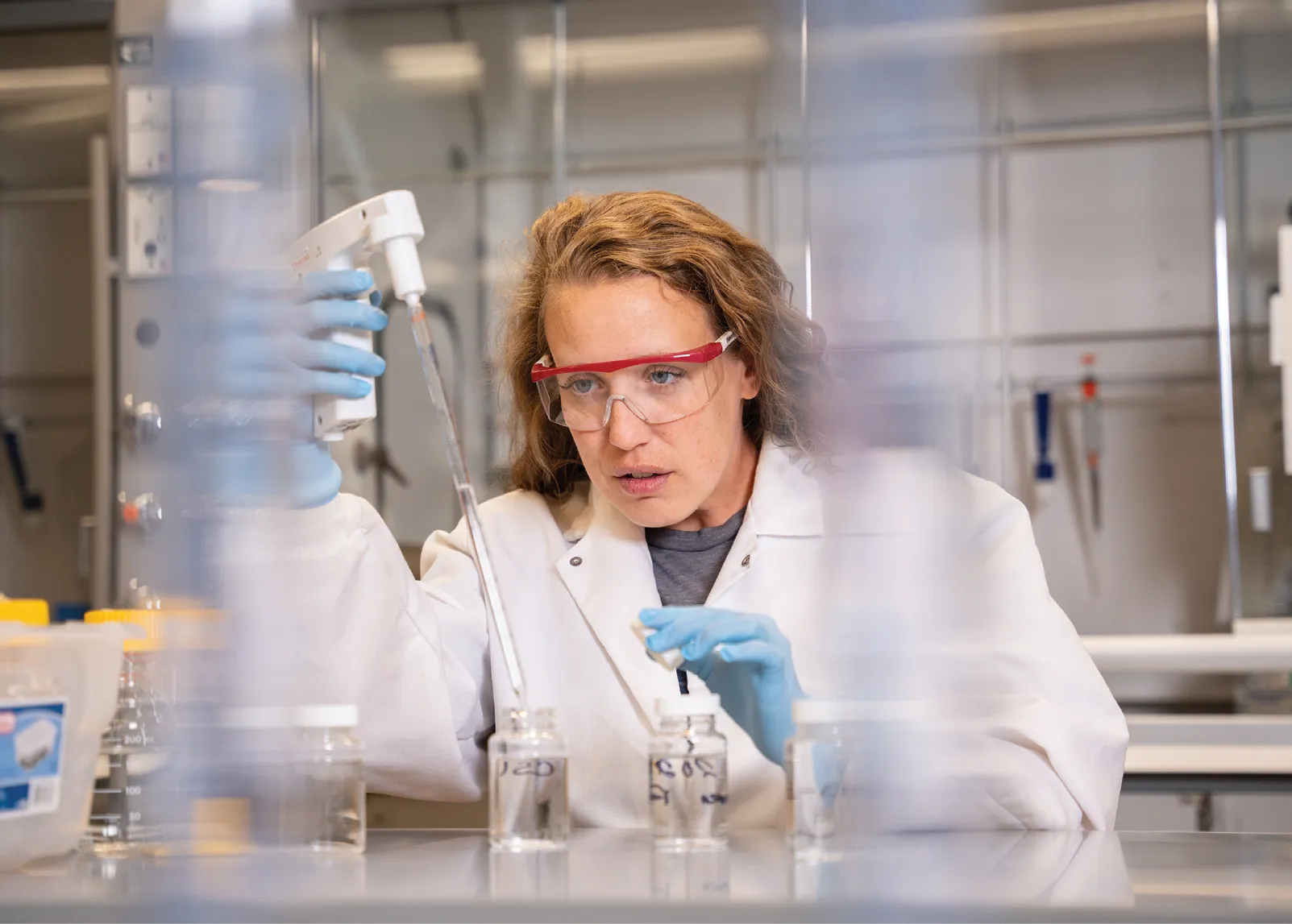
Currently, one of the biggest impacts and concerns for Charleston Waterkeeper involves plastic pollution and microplastics, and once again, the nonprofit’s work in studying and tracking microplastics in our waterways has been directly tied to its ongoing partnership with the College. Britney Prebis ’24 began interning with Waterkeeper in 2022 as a graduate student in the College’s Environmental and Sustainability Studies Program. She worked with her adviser Barbara Beckingham, director of EVSS, to create a Waterkeeper plastics monitoring program much like Carmack-Smith’s water quality one.
A focus on plastic pollution wasn’t new to Waterkeeper. In 2016, the nonprofit used what limited data it had to successfully push for a single-use plastics ban in seven of our coastal communities, and after a 2019 spill of nurdles – tiny pellets used in plastics manufacturing – in Charleston Harbor, it successfully lobbied the South Carolina Senate to pass an anti-plastic pellet bill and prevailed in a federal lawsuit, in partnership with the Coastal Conservation League and the Southern Environmental Law Center, to hold the nurdle polluter, Frontier Logistics, accountable. Despite this track record, the nonprofit needed a more systematic approach to microplastics data collection and identifying microplastics concentrations in the Charleston watershed, which they can then use to drive policy change.
Charleston Waterkeeper has benefited immensely from partnering with graduate students from the College, notes Wunderley. “It’s strategic for us as a small nonprofit to have longer-term commitments from our interns. Thanks to people like Lucy Davis, Dr. Callahan and Dr. Beckingham, we get paired with great students, and then we invest in them. When you have a graduate thesis on the line, students are motivated. It helps that we offer a great mix of academic research and real-world application – everyone has vested interest.”
Charleston Waterkeeper has had an equally excellent track record with CofC undergraduates through the Bonner Leadership Program, a four-year, service-based scholarship program. Bonner Leaders commit to interning with a local nonprofit for three years, and those who have interned with Charleston Waterkeeper have been integral to developing and staffing their initiatives.
Brittnany Graham ’20 worked with Carmack-Smith on water quality testing, waterway cleanups and early microplastics initiatives during her years as a marine biology undergrad and Bonner Leader and now is pursuing her master’s in wildlife and fisheries biology at the University of Tennessee. “Waterkeeper set me up for success,” says Graham. “The data management experience I got at Waterkeeper was invaluable, and it taught me how to use data to guide public policy and long-term waterway management implications.”
Wunderley would take it a step further, acknowledging that, yes, community volunteer effort is invaluable to Waterkeeper’s success, but the College has been and continues to be the linchpin.
“They’re that key piece that has provided the right level of support, whether it’s a connection to a student or intern or the use of laboratory resources, that allows something to bloom or amplify,” he says. “There’s mutual respect – the professors see the level of work we’re doing, and because the College is a university that’s very aware of the community it belongs to and represents, the faculty want to encourage that, and these partnerships develop. I can’t imagine doing this work without the College of Charleston.”