


giving props
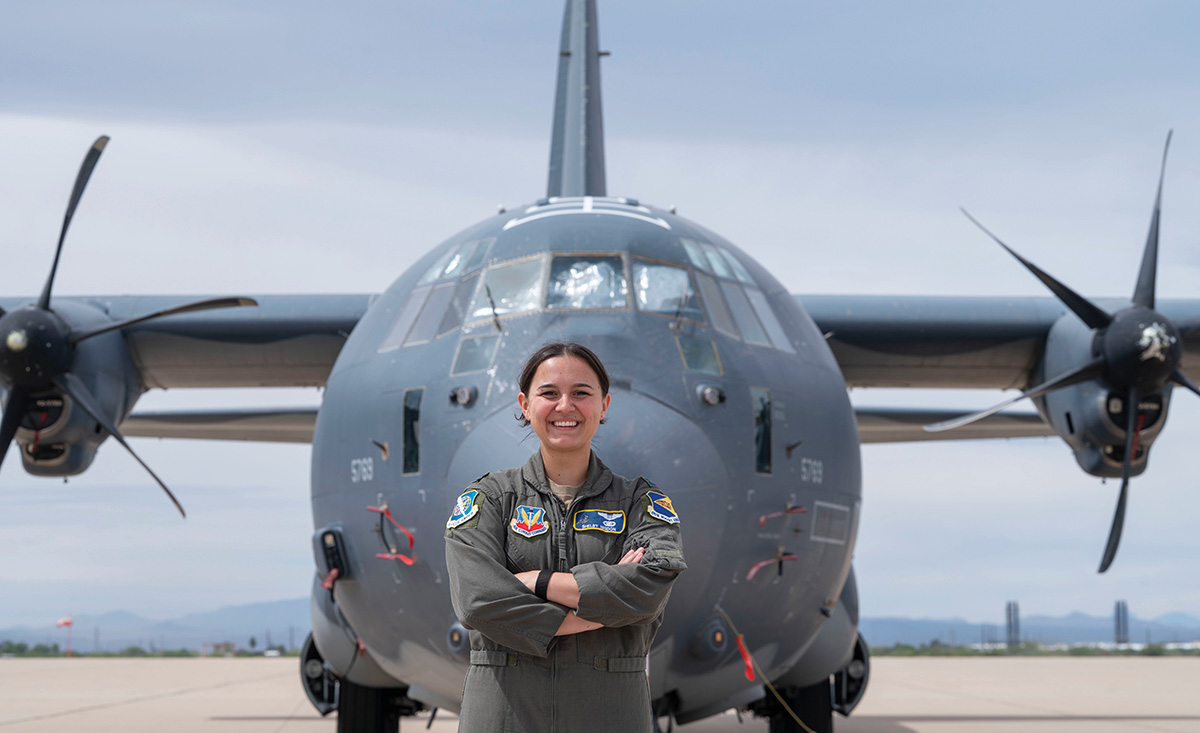
The Davis-Monthan Air Force Base in Tucson, Ariz., home of the 79th Rescue Squadron, is a long way from Wednesday night karaoke at Burns Alley near the College, where she and her best friend once carved out a single evening of freedom between classes, work shifts and late nights at Addlestone Library.
And for most of her life, it wasn’t supposed to happen at all. She was certain – completely certain – that the military wasn’t for her. But, after dating someone who explored a military career, Higdon decided to join the College’s Air Force ROTC program. She had already set her sights on a degree in communication because it’s such a universally useful skill.
After earning her bachelor’s, Higdon left the Lowcountry for Los Angeles Air Force Base, where she became an acquisitions officer (AO) for the Space Enterprise Consortium (SPeC).
Her role was to help award space prototype contracts in under 90 days – a real challenge in an industry that, despite its rocket capabilities, is infamous for its lack of speed.
Fortunately, Higdon was able to draw on the skills she developed at the College to help SPeC land contracts quickly, including one exceeding $12 billion. She credits Elena Strauman and Kathleen DeHaan, associate professors in communication, as major influences on her success.
“It was a really jargon-heavy and technical organization,” she says of SPeC. “I applied Dr. Strauman and Dr. DeHaan’s lessons to develop public releases and communications plans in a way that anyone could understand.”
After three years as an AO, Higdon was nominated by her commander to participate in the Air Force Air Education and Training Command’s highly competitive Rated Preparatory Program to gain aviation skills. Though she didn’t land her first choice as a pilot, she’s elated with her role as a combat systems officer (her second choice). From planning routine airdrop and refueling missions to coordinating full-scale search-and-rescue efforts, Higdon says no two days are the same – and it’s about as far from boring as you can get.
Whether determining which parachute gets used for different personnel and cargo, or mapping out scenarios based on changing weather, every little decision can have a major impact on the success of a mission.
“It’s our job to find out as much info as possible so we can aid the HH-60 helicopter in performing a rescue,” she says. “It’s a really cool job.”
For someone who once swore the military wasn’t for her, Higdon is exactly where she’s meant to be.
“Being in the military is the ultimate learning experience,” she says. “It’s the most wild, chaotic fun. So much growth occurs.”