

Ship Shape

By Margaret Loftus
Photography by Catie Cleveland
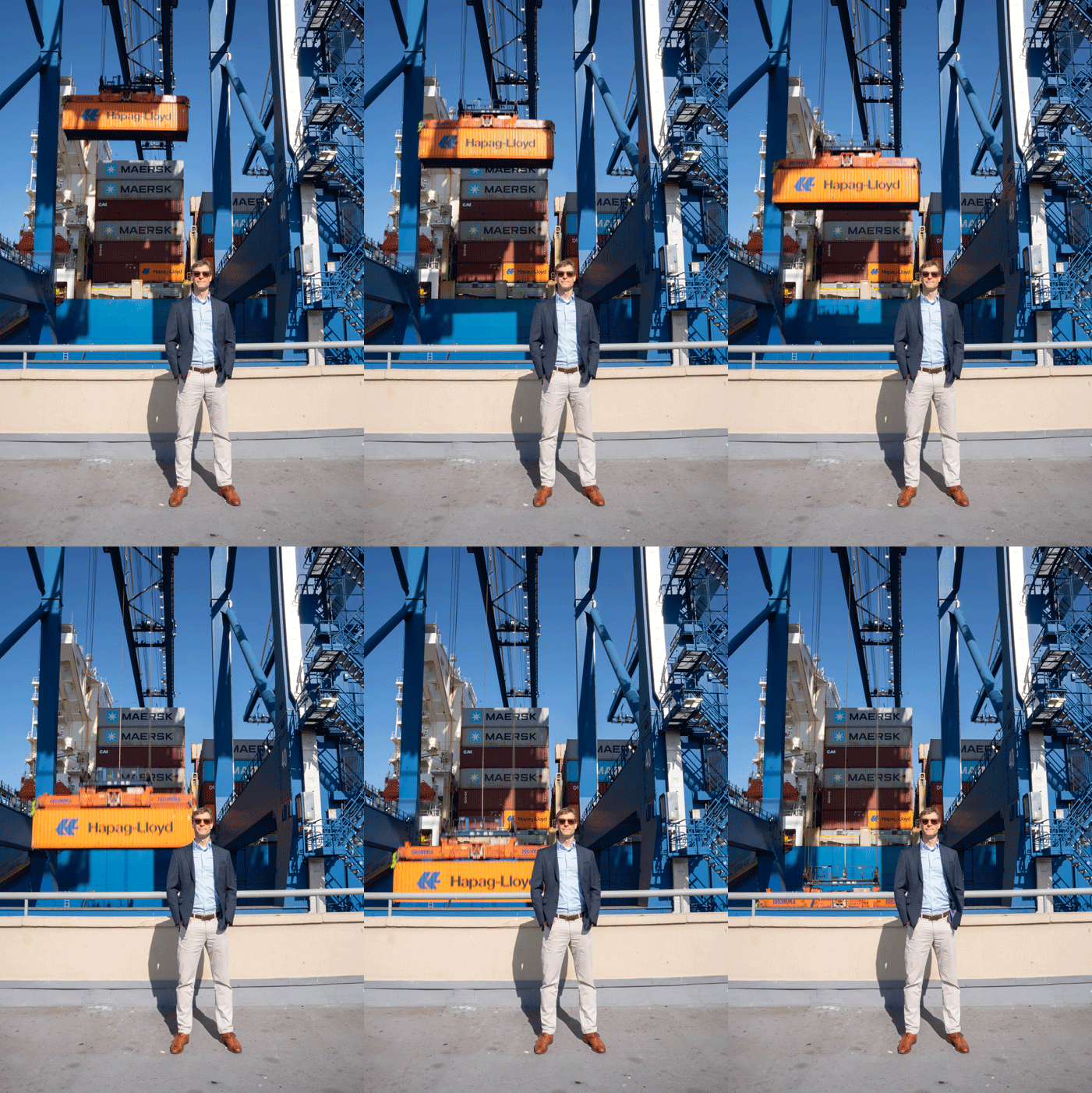
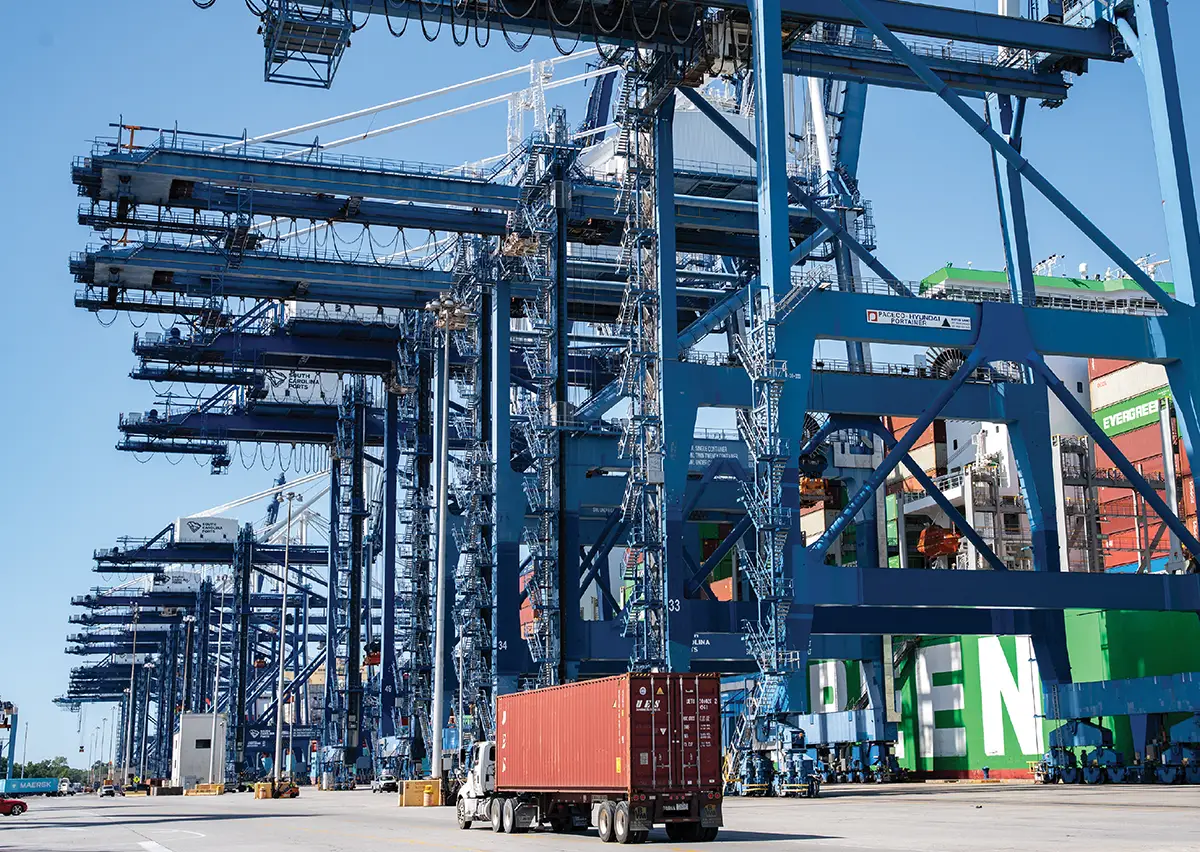
hipping containers in a kaleidoscope of orange, magenta and seafoam green are stacked six high in places at the Wando Welch port terminal in Mt. Pleasant, casting late afternoon shadows as cranes hoist more Lego-like units from the belly of a dockside ship.
“Sometimes one hatch is being unloaded with imports, and the hatch next to it is being loaded with exports,” explains Micah Mallace ’07 (MBA ’11), the CEO and president of South Carolina Ports. More than ever, time is money: Ships spend an average of 12 hours in port. “The days of ships taking a week to unload and the sailors going to the bars – yeah, those days are long gone,” he says.
The movement of goods via freighters, trains, planes and trucks has enthralled Mallace since he was a kid. So, when it came time for him to choose a major as an undergrad, his mother nudged him toward the College of Charleston’s supply chain management program. It wasn’t a hard sell, and after graduation and a stint in hospitality and commercial real estate, he went back to campus to earn an MBA with a focus on finance, which set him firmly on the path he’s on today.
Mallace started at SC Ports fresh out of business school in 2011, climbing the ladder from inside sales to chief commercial officer in the span of 10 years. In 2022, he left the port to helm Harbor Logistics, a third-party transportation and logistics company in North Charleston. But last October, he returned to SC Ports as its seventh CEO.
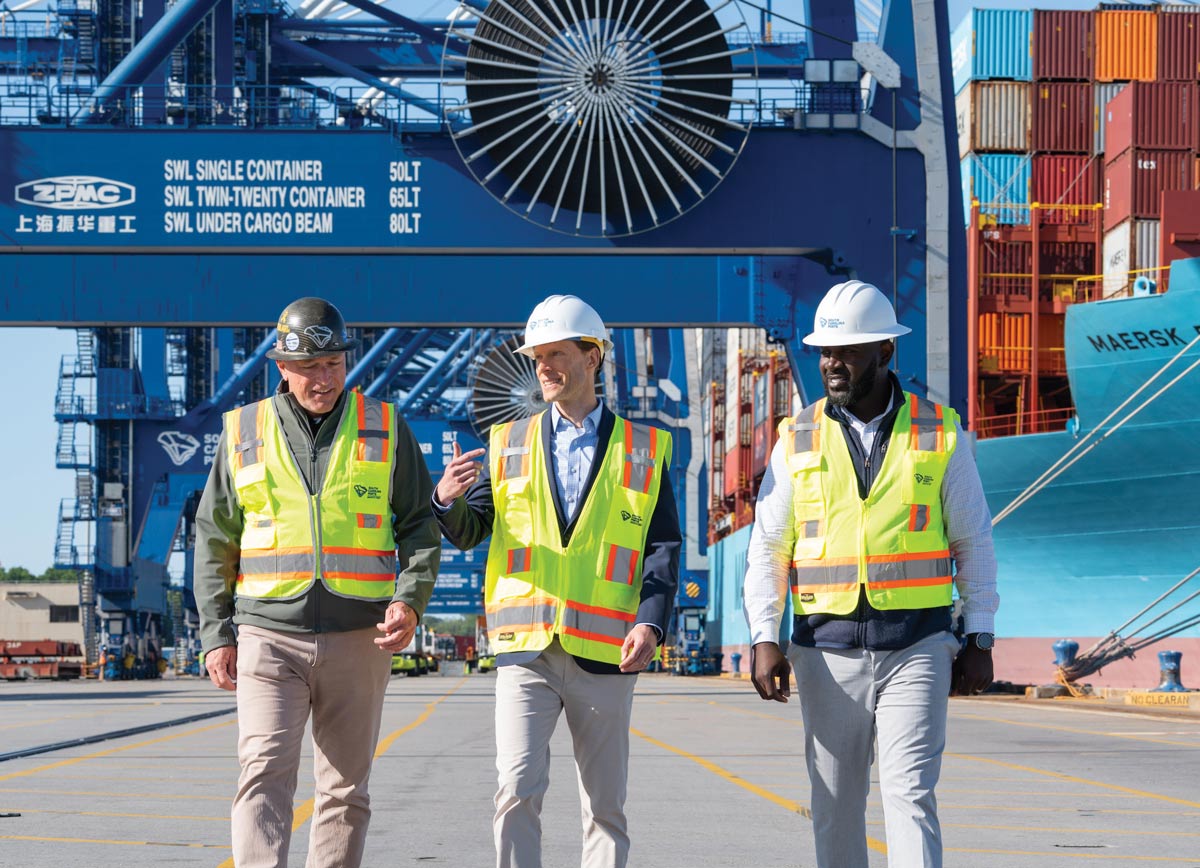
He now heads up a staff of 735 employees spread across four marine terminals – at 689 acres, Wando Welch is the largest – and two inland ports in Greer and Dillon. But his influence and that of the port extends well beyond its shipping operations: One in nine jobs in the state are fueled by the system. That’s more than the one in 10 jobs supported by another of the state’s big revenue drivers, tourism.
“The port serves a bigger purpose in itself,” he says. “We really exist to drive economic development. What we do allows for people to be employed all over the state – and really, the region – and it allows those people to put food on their dinner tables for their families.”
“We are incredibly fortunate for the ocean harbor we have,” Mallace says – “some natural things that just set us apart.”
What’s more, the infrastructure is enviable. A $2-billion expansion program completed in 2021 entailed building the Hugh K. Leatherman Terminal in North Charleston and deepening the harbor to 52 feet at low tide, making Charleston one of the deepest ports in the country, with a channel that can accommodate two ships side by side. (A fully loaded freighter requires a water depth of 50 feet.)
Perhaps above all, Mallace values his team. “The idea of a CEO having all the answers is, in my opinion, bunk,” he says. “The team figures out all the answers together.”
He looks at his role in the operation as a problem solver. “Wherever there are obstacles that stand in the way of our goals, my job is to support the team in finding ways around those challenges,” he says. “Or, if those challenges are greater than the team, then my job is to personally remove those obstacles.
“For example, one of the port’s largest customers had an issue that risked the entire business between it and the port,” he adds. “I did not deliver the answer to the problem; the team did. They came up with the options, analyzed to identify the best one, engineered the infrastructure needed, convinced the customer of the new option’s merit and fixed the issue.”
Home Away from Home
Thanks to his previous decade-long run at the port, he’s got a lot of support. Mary Beth Richardson, SC Ports’ vice president for strategy and analytics, met Mallace when he was an MBA student.
“My first impression was that he is bright, genuine and engaged,” she says. “Nearly 15 years later, I feel exactly the same. As our CEO, he is a thoughtful leader with a keen focus on growing and improving the business. In his first few months back, he has challenged our team to think outside of the box to drive business and change.”
That he has a successful career and roots in Charleston – he and his wife, Katie ’07, have a 7-year-old son and 5-year-old twin daughters and live in Mt. Pleasant – is ironic considering how he ended up at the College. With his twin brother committed to an expensive private college, Mallace chose the College in the hope of saving some money for his mother, who had pledged to foot both bills.
“I was choosing between the University of Pittsburgh and here,” he recalls. “And I thought, Well, Charleston is a lot cheaper, and if I hate it, I can transfer. So I guess the storyline there is really value – that was the underlying driver for coming here.”
It didn’t take long for Mallace to fall for the school and the city. “I do remember thinking this was a beautiful place,” he says. “I think I called my mom two weeks, maybe a month, after having moved here and said, ‘Mom, I don’t know if I’ll ever leave this place.’”
Growing up on the north side of Chicago and Old Lyme, Conn., Mallace always knew he wanted to work in a global industry. Both his parents worked in international business and had lived abroad, and travel was a big part of the family’s life.
“The stories that we always heard growing up were about various cultures, and having a German boss and a French colleague, the cultural nuances,” he recalls. “I always knew I would wind up in something that was a little more global, where there was the opportunity for dealing with other cultures.”
Along the way, he jumped at the opportunity to spend part of his junior year with his brother on Semester at Sea, a floating classroom with ports of call all over the globe. “Seeing these industrial ports just felt like, That’s the global economy,” he says. “If you go to Nigeria, Russia, Hong Kong, there’s a container terminal that looks a lot like this one. Yeah, their culture is different, (but) trade is a unifying factor, and that spoke to me.”
Chain Reaction
“It was fascinating that something you read about in The Wall Street Journal or The Economist you can actually see in our industry,” says Mallace. “You know, if there’s a burgeoning, growing middle class in Asian economies, we see pork and poultry exports growing like crazy because the first thing that people start to change as they move into the middle class and have some discretionary income is they start to put protein into their diet. It kind of grabbed me. And I always thought, If I could get into that industry, that’d be pretty great.”
One of the highlights of the program was spending a week in the Netherlands, where one of the facilities he and his classmates visited was the world’s largest flower warehouse, essentially the epicenter of the industry in the country (the Dutch control more than half the global flower market). This was distribution on a massive scale – moving lightning fast, thanks to the blooms’ short shelf life.
“We had this week of just one amazing supply chain experience after another,” he says. “It’s great to know the theory, but being able to touch and feel and see firsthand – that’s something that the supply chain program at College of Charleston does that is pretty unique. It’s not just all theory. It’s actually, ‘How do you apply that theory?’ I still benefit from that today. So that was a real crystallizing moment.”
Another memorable teacher was finance professor Jocelyn Evans, the former chair of the Department of Economics and Finance. In her class, Mallace says he “learned how everything, ultimately, can get calculated, pushing hard to make everything an objective decision.”
Mallace’s experiences at the College have led him and his wife Katie to give back by establishing the Micah & Katie Mallace Faculty/Staff Service Excellence Award for School of Business employees who consistently demonstrate exceptional commitment to serving students, colleagues and the broader College community. The first of its kind at the school, the award is endowed and will be given to faculty and a staff member on alternate years.
Back at the port, Mallace has his hands full, not just with his plan to win back the claim of fastest-growing port, but also with global attention focused on the Strait of Hormuz, which is critical to so much of the world’s oil supply and energy prices. But being nimble is just part of the job.
“It’s exciting,” he says. “You have to love change. You have to be motivated by, ‘Let’s solve this problem.’”