


Evolution of a Museum
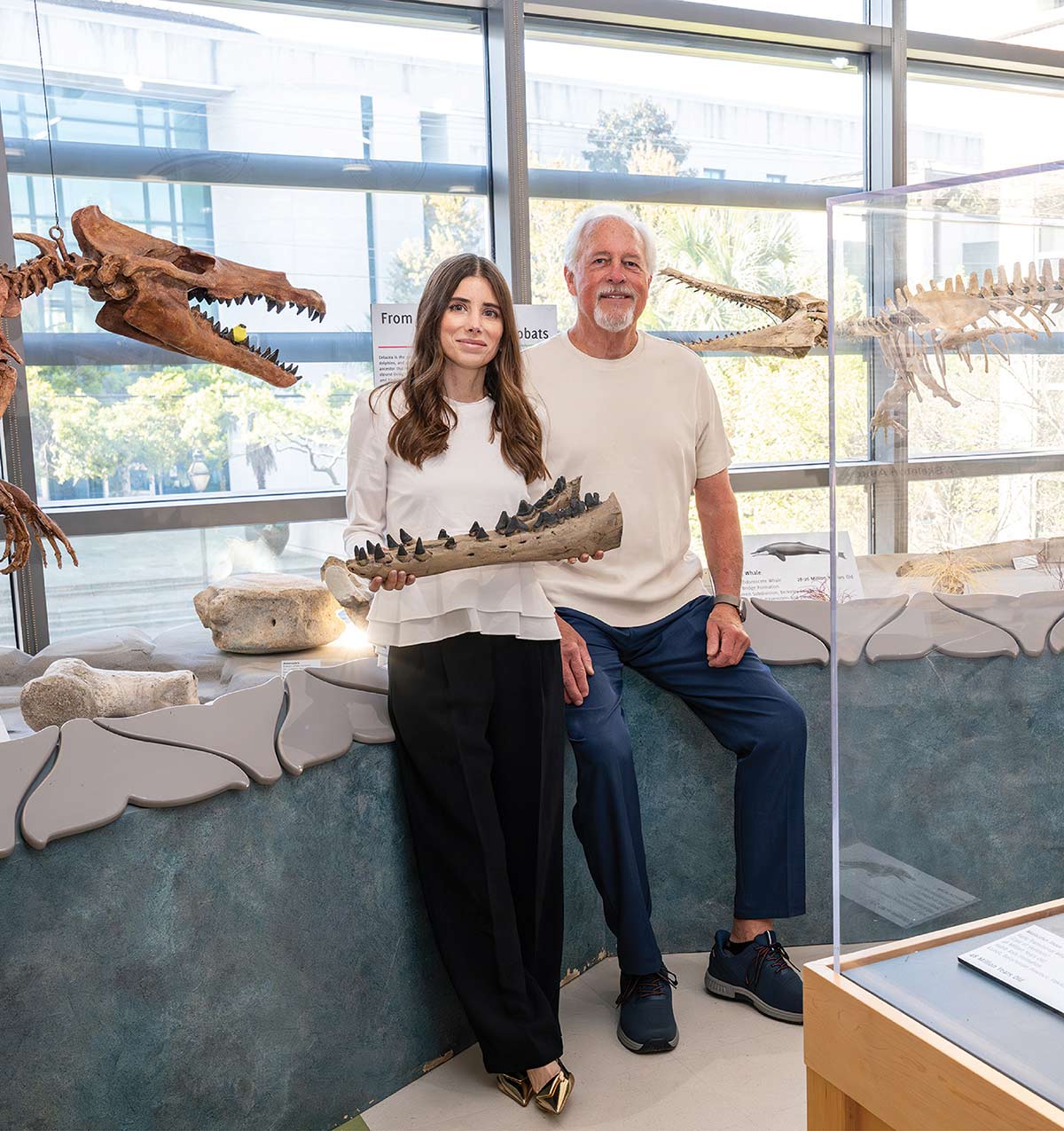
Brown and Kane, who earned a doctorate at Harvard, discovered a shared passion for fossils when they met in 2023. Brown, a local businessman, had donated his 5,500- square-foot collection of fossils – valued at more than $1.6 million – to establish the Mace Brown Museum in 2010. Kane founded the Charleston Center for Paleontology, a 10-plus–acre land conservation and research site in Ridgeville, S.C., known for its marine fossils from the late Oligocene to early Miocene epochs (23–28 million years old). Both had a desire to delve into the Lowcountry’s unique geology, including why it contains a plethora of marine fossils documenting the golden age of whale evolution.
When Brown moved to Charleston in 1992, discovering the abundance of prehistoric shark teeth in the area sparked his passion for fossil collecting. He adorned his Meeting Street office with his collection and welcomed CofC students to view them. In 2006, then-president Lee Higdon offered Brown dedicated space to establish a museum for his collection at the College’s new science center. After years of planning, in April 2010, the Mace Brown Museum of Natural History opened its doors on the corner of Calhoun and Coming streets. Since then, the museum has grown in popularity with more than 20,000 visitors in 2025.
“What has been done in terms of published citations on cetaceans and marine life has established our museum as a prominent resource for research of those fossils,” says Brown. “Many of the specimens are holotypes, a special designation given to fossil specimens that are used to describe new species. We plan to build on all this and develop a continuing post-doc research program.”
Kane’s passion for paleontology began in graduate school at Harvard and was reignited in 2017 when she moved to the Charleston area and discovered fossil shark teeth at local beaches. With her research site and laboratory in Ridgeville and its laboratory merging energies with the museum, Kane looks forward to creating community programs.
“For many students, fossils are a gateway to a love of STEM,” says Kane. “We are excited that local middle and high schoolers will be able to engage with world-class research in their own community.”
Kane hopes the museum can be a nexus for the Lowcountry, showing the benefits of industry and academic collaboration. “Most local specimens were discovered during excavation due to development and construction,” she explains. “As we build out our museum advisory board, we aim to strengthen our connections in this area.”
President Andrew T. Hsu believes Brown and Kane’s plan will increase community engagement and the College’s national prominence.
“We are so grateful to have Mace Brown and Elizabeth Kane on our team,” says Hsu. “Their vision for the museum will not only expand interaction and awareness about the Lowcountry’s unique geological resources, but will bestow national distinction on the College as a world-class research center.”