


Playing Through
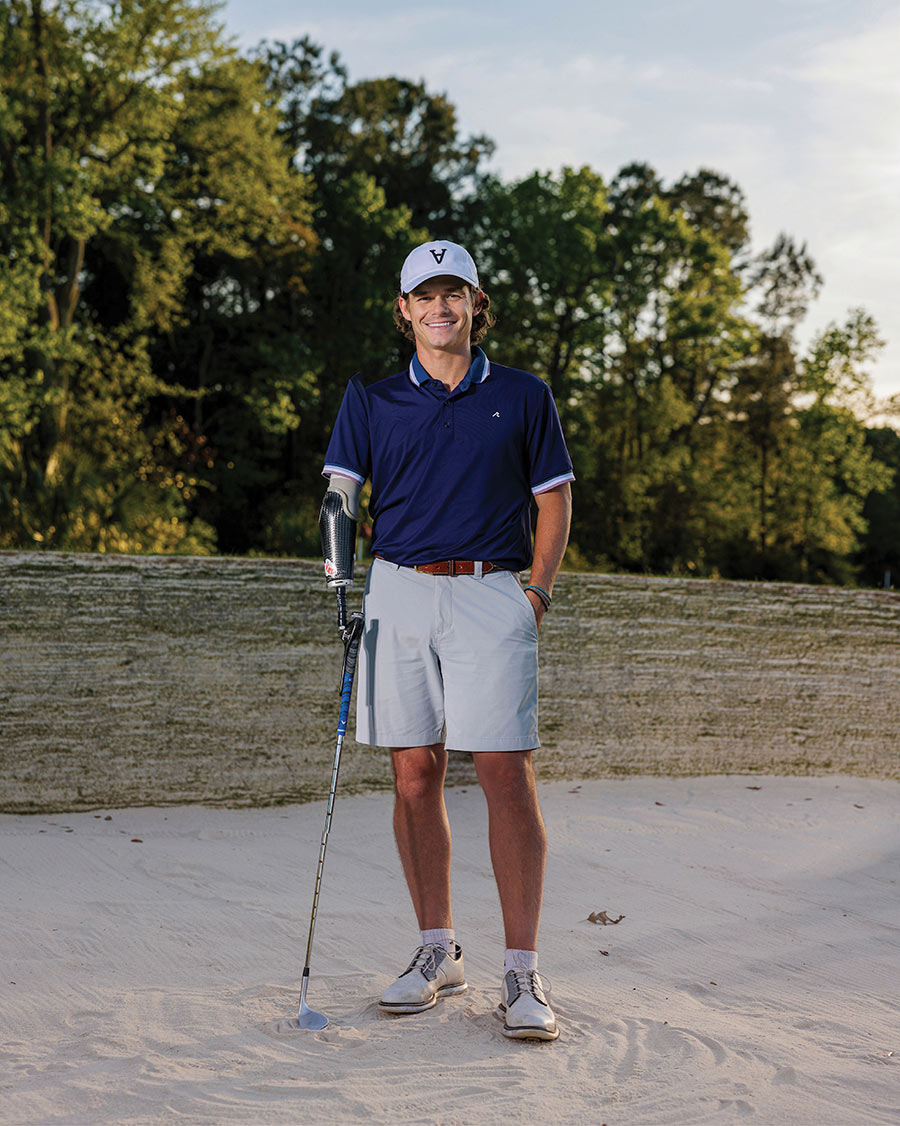
“You’ve changed my life,” said Joe Morrissey, whose wife was pregnant with a child missing his right hand and forearm just like Austen.
After Morrissey saw Austen acting like any other teen on a summer day, his whole attitude changed. His son, Tommy, would go to become a golf prodigy of some renown.
Austen has inspired a lot of people over the years with his athletic ability, whether on the baseball diamond, the soccer pitch or the basketball court. Now, with the help of a prosthetic and a club attachment, he’s making a name for himself in the adaptive golf world by qualifying for the sport’s biggest event: the U.S. Adaptive Open, July 6–8 in Rockville, Md., for the second straight year.
“It’s such a cool experience for us adaptive athletes,” says Austen. “They (the United States Golf Association) give you a locker with a nameplate and treat you like a professional for the week. It’s pretty special.”
Austen’s mother, Mary, was 18 weeks pregnant when an ultrasound revealed that a random vascular accident meant that her son’s right hand “didn’t punch through” and would end mid-forearm. The doctor’s counsel took her aback.
“His problem is going to be you and you,” he said, pointing at her and her husband, Peter. “If you have a problem with it, he will have a problem with it.”
Mary bristled at the shallow implications on the car ride home. “But looking back, it was a great way to frame it – treat him like any other child; he’ll be fine,” she says. “And we did.”
Adds Peter: “We certainly couldn’t teach him to tie his shoes with one hand. He had to figure that out on his own.”
His three brothers and sister never gave him a pass either, and Austen never felt sorry for himself or even felt the need to wear a prosthetic to stop some people from staring.
In Little League, some coaches would try to exploit his fielding disadvantage by bunting on him when he pitched, but he’d quickly stick the mitt under his right armpit as he scampered for the ball and throw the batter out.
His senior year of high school, the baseball team won the district championship with Austen throwing in the mid-80s in the title game.
After earning a business degree from the College, he started playing more golf during the pandemic. He wears a silicone sleeve on his right arm that locks into a custom carbon-fiber socket; a clamp slides up the club from the shaft and tightens over a standard grip.
When he’s not working on his game in Charleston, Austen coaches middle school baseball and basketball teams at Porter-Gaud School and runs the after-school programs there with brother John ’24, the director of auxiliary programs. Austen has also become a bit of a golf influencer with almost 46,000 Instagram followers (@jimmythekiiid).
“Coaching and the content creation lean into what I’m trying to show people – anything’s possible,” he says. “I want the seventh and eighth graders to see that if I can do it, then they can do it.”